

Join 4,000+ boatowners
Sailing season starts in
You missed out!
The ultimate
Marine Diesel Engine Maintenance Online Course
with Nigel Calder & Dr. Jan Athenstädt
All You Need to Know About Boat Engines
On-Demand Online Course • 63 Lessons • 11+ Hours of Video
The most comprehensive online resource on boat diesel engines. No pre-existing knowledge required!
As featured in





Why Maintenance Matters

Some Expensive Examples for Maintenance Related Issues
Below are a few examples of mistakes and maintenance neglect that we see all too often.
All of these could have been prevented with proper maintenance.
Damage from Poor Fuel SupplIES AND INADEQUATE FUEL MAINTENANCE
By far the most common cause of engine trouble is poor fuel supplies and inadequate onboard maintenance. This not only clogs filters. It leads to expensive injection pump and injector damage. Especially with modern common rail engines.
Do you have water or bacteria in your fuel tank? Do you know what fuel filters to choose to protect your injectors from damage?
Hint: It's more than just their nominal micron rating...
Average cost for replacing a fuel injector: $700
Total cost for a 4 cylinder engine:
~ $2,800

Pitting corrosion on a Bosch fuel injector nozzle tip
Total loss from IMPROPER InstallationS
On almost all sailboats and many powerboats, if your engine is not properly installed it is at risk of seawater flooding. It may work fine for a few years, but once the raw water pump impeller wears or loses vanes, engine flooding is an ever present possibility. If you are lucky, you can flush the salt water out of the engine. If not, you end up with massive corrosion and/or mechanical damage. It happens far too often!
Do you know whether your raw water cooling and exhaust systems have been installed in a manner that prevents sea water intrusion?
Cost for flushing an engine:
~ $2,000
Replacement costs in case of total loss:
~ $10k to $50k

This engine was installed without a siphon break with a risk of saltwater flooding. It also suffered from a general neglect of maintenance
Devastating Corrosion Damage
The raw water system of your engine contains warm to hot sea water, which is corrosive. Depending on the complexity of your engine, this water flows through various heat exchangers before reaching the exhaust elbow.
Even if the sacrificial anodes in this system are regularly replaced (which is not always done), corrosion issues are still not uncommon. In particular, with heat exchangers that incorporate galvanically incompatible metals (such as cupro-nickel and aluminum).
Do you know whether your heat exchangers (in particular intercoolers) are on the high-risk list of corrosion issues? When was the last time you took them apart to clean them and check for signs of corrosion?
Cost for a new intercooler: ~ $1,500 to $4,000

This intercooler core corroded into an aluminum case. This is not salvageable
Carbon Buildup Ruining Engines
If a mechanically injected engine is subjected to a duty cycle with short run times at light loads (very common, in particular with sailboat engines and generators), poor combustion leads to carbon formation.
This not only leads to decreased performance through fouling of the exhaust system. It also significantly reduces the lifespan of the engine and in some cases can require a total rebuild in less than 1,000 hours of operation.
Do you know how to run your engine to ensure full combustion and minimize carbon formation?
Cost for an engine overhaul: ~ $ 4,000 to $8,000

This sailboat engine has 700 hours on it and already requires a total rebuild
What You Get When You Sign Up
We continiously improve and expand our content based on your feedback.
Here are a few examples of our animated graphics from the videos and lecture notes
(click on an image to enlarge)


Ideal for visual learners:

Nominated for the DAME Design Awards 2025
Course Syllabus
About This Course
How to Use this Course
Safety Precautions
Maintenance & Overhauls
Module 1 Quiz
The Combustion Process
Conventional Injection Systems
Engine Operation
Engine Cooling
Turbochargers
Reducing Emissions
High Pressure Injection Systems
Module 2 Quiz
Engine Access
Engine Mounts
Fire Fighting Equipment
Raw Water Cooling Systems
Exhaust Installations
Hose Clamps
Fuel System
Air & Noise
Module 3 Quiz
Fuel System Introduction
Fuel Properties
Fuel Contamination
Tank Sampling
Fuel Treatment
Tank Cleaning
Module 4.1 Quiz
Particle Counts
Filter Ratings & Limitations
Water Separation
Primary Filter Setups
Module 4.2 Quiz
Changing Primary Filters
Changing Secondary Filters
Priming Filters & Bleeding the Fuel System
Module 4.3 Quiz
The Oil System
Oil Filters
Oil Change Schedules
What Oil to Use?
Oil Change
Module 5 Quiz
Raw Water Circuit
Raw Water System Maintenance
Impeller Change
Sacrificial Anodes
Descaling Heat Exchangers
Siphon Breaks
Exhaust System
Module 6.1 Quiz
The Freshwater Circuit
Freshwater Pump Belt Maintenance
Types of Antifreeze
Changing the Antifreeze
Module 6.2 Quiz
Air Supply
Crankcase Ventilation
Air System Maintenance
The Exhaust Side
Module 7 Quiz
Damper Plates
Transmission Configurations
Clutches
Transmission Maintenance
Couplings & Joints
Stuffing Boxes
Dripless Shaft Seals
Shaft Bearings
Propeller Installations
Saildrives
Module 8 Quiz
Final Words
General Tips on Tools
The 90% Toolkit
The 10% Toolkit
Spare Parts
Module 10.1 Quiz
Cranking Problems
Slow Cranking
Getting Water Out of the Engine
Engine not Firing
Smoke Diagnostics
Overheating
Other Problems
Electrical Issues
Module 10.2 Quiz
Engine Preparation
Cooling System
Longer-Term Layups
Module 10.3 Quiz
Valve Adjustment Mechanisms
Establishing Cam Position
Adjustment Process
Module 10.4 Quiz
Engine Alignment
Repowering vs. Rebuild
Module 11 Quiz
Testing an Engine
Module 12 Quiz
Optimized Efficiency
Engine Performance Curves
Module 13 Quiz
Why you should Sign Up Now
Stay Safe on the Water
A reliable engine is crucial to a boat's safety at sea. Imagine entering a harbor in heavy seas on a lee shore and your engine quits a few feet from the breakwater!
Save 1,000s of Dollars, Pounds or Euros
Good diesel mechanics are expensive - and hard to find! If you learn how to maintain (and troubleshoot) your engine yourself, over time this will easily save you four-digit fees.
Be Self-Reliant
Knowing your engine and being able to troubleshoot it can mean the difference between a wonderful vacation - or a few weeks at the boatyard.
Master your Systems
Obtaining a deep understanding of your boat's systems is not only empowering. It can be fun as well! Diesel engines are fascinating pieces of equipment. Learning their intricacies will make you appreciate the decades of engineering and gradual improvements that make them the reliable companions they are today. (If they are treated well!)


The course content is compliant with ABYC and ISO standards
Sign Up Now - Risk Free
One time fee: US$299
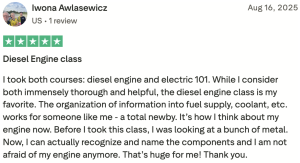
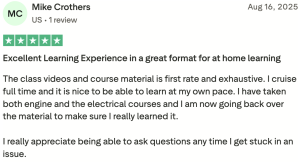
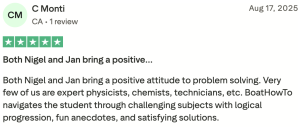
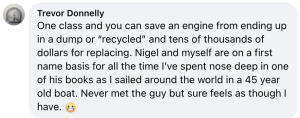
What our students say



















We're looking forward to seeing you in class!


Dr. Jan C. Athenstädt

Nigel Calder
© 2026 BoatHowTo